.png)
Many residential builders and trade contractors rely on a simple approach to support employees who drive for work: a monthly vehicle allowance. It looks straightforward. Payroll is predictable. Administration is minimal. But simplicity comes at a cost.
Fuel and maintenance costs can add up fast. For service-based construction organizations, these costs often rank among the largest operating expenses after labor. When bundled into a flat allowance, spending becomes difficult to see, control and improve. What appears efficient on the surface can quietly erode margin over time.
What a Monthly Vehicle Allowance Really Covers
A vehicle allowance is a fixed payment added to payroll to help cover business driving costs such as fuel, maintenance, and vehicle wear. Key challenges with monthly vehicle allowances include a lack of visibility, uneven costs between drivers, and unnecessary tax exposure. These structural issues often remain hidden until companies attempt to analyze fuel spending or tighten operational controls.
Lack of Data and Visibility
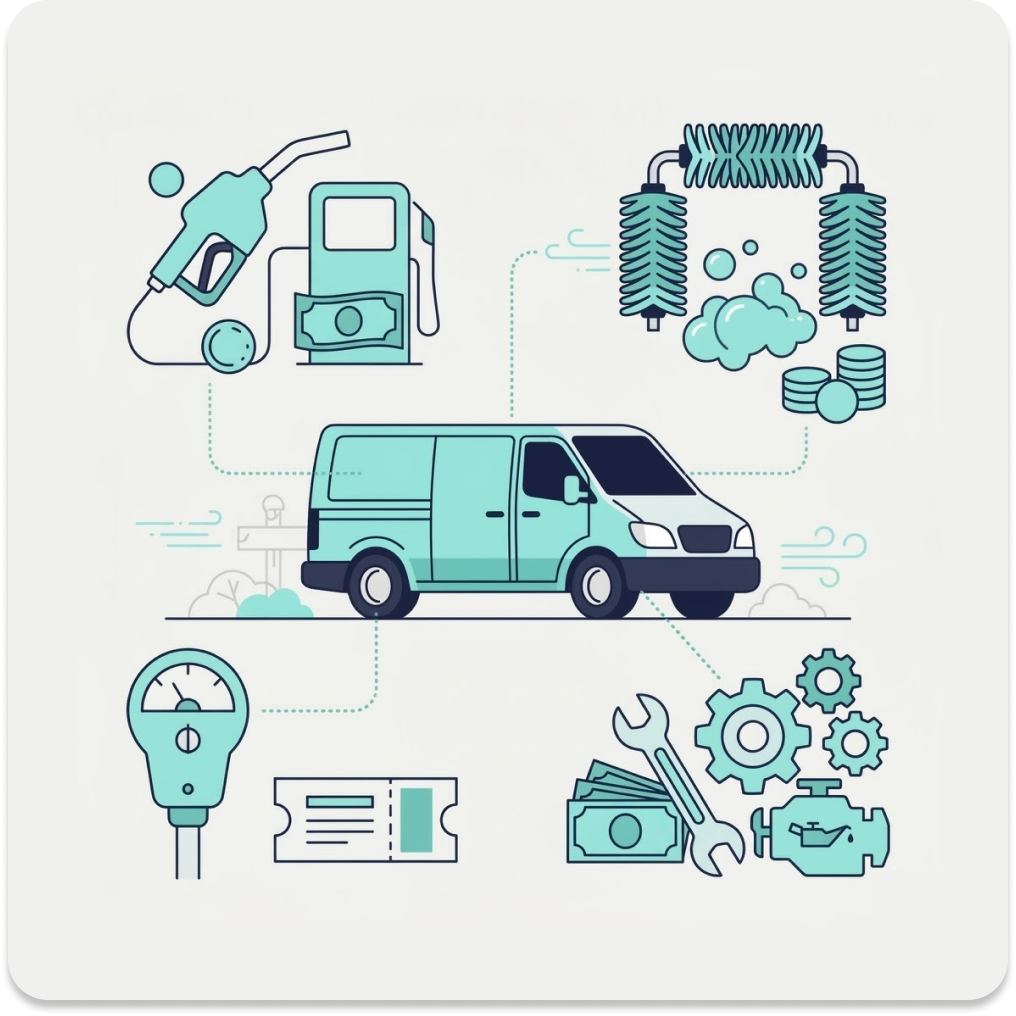
When vehicle expenses live inside payroll, transaction level visibility disappears. Leadership cannot see how much fuel each driver consumes, which crews consistently spend more than average, whether purchases align with preferred vendors, or whether maintenance is routine or reactive. Instead, the business sees a single fixed number each month.
This turns fuel from a controllable cost into a blind spot. Decisions are made based on assumptions rather than actual usage. The scale of this blind spot is significant. In 2025, construction companies commonly paid between $400 and $850 per month per employee as a vehicle allowance. That equates to $4,800 to more than $10,000 annually per driver. Across dozens or hundreds of employees, the aggregate exposure becomes substantial especially when there is no data to confirm whether that spend reflects reality.
Driver Inequity: One Allowance, Unequal Costs
Monthly vehicle allowances assume drivers incur similar expenses. They don’t. One employee may drive long distances to job sites every day. Another may work mostly within a small service area. Both receive the same fixed allowance.
The result is uneven outcomes. Some drivers cover real business costs out of pocket. Others spend less than the allowance provides. Over time, the gap creates frustration and hard conversations, especially when fuel prices rise. A static allowance can’t adjust to actual driving. It rewards estimates, not reality.
Tax Implications: Vehicle Allowances Inflate Payroll
Most allowances are structured as non accountable plans, and that distinction is costly. Because employees are not usually required to substantiate business use with receipts or mileage logs, tax authorities treat every dollar of the allowance as ordinary income. For an allowance to be non taxable, it must be based solely on business kilometres or miles driven, and employees must keep detailed records to prove it, including a log of every work trip with the date, destination, and purpose.
A flat allowance often makes tracking nearly impossible in practice. Without a system that captures when and why the vehicle was used, there is no reliable way to separate business travel from personal travel or satisfy the documentation requirements that keep the allowance out of taxable income.
The result is a quiet tax drain on both sides of the paycheck. Employers pay payroll taxes on top of the allowance while employees owe income tax on money they never actually receive as take home pay. Combined, roughly 30 to 40 cents of every allowance dollar goes toward taxes rather than fuel. A company paying $600 per month per driver is not delivering $600 in transportation value. It is closer to $400, with the rest absorbed by the tax system.
There is also an audit risk that compounds this issue. Without transaction level records showing when, where, and why a vehicle was used for business, those payments are difficult to defend under scrutiny. A compliant reimbursement program requires a clear documentation trail that holds up when tax authorities ask questions.
Tax Clarity: Separate Personal Benefit From Business Spend
A cleaner approach is to separate personal vehicle compensation from business fuel and maintenance. Employees receive a defined taxable benefit that covers personal vehicle use, while business fuel and maintenance are handled as company expenses.
When fuel and maintenance are paid through a controlled program, each purchase is tracked and documented. This creates a clear record of business spend and supports policy enforcement. The separation clarifies responsibility. Employees know what portion of compensation covers personal use. The company manages fuel as an operating cost. Finance receives clean reporting and operations gain usable data.
You Cannot Optimize What You Cannot Measure
Most operations leaders suspect there is waste in fuel and maintenance, even if it is difficult to quantify. It appears as inconsistent spend patterns, unexpected monthly fluctuations, and ongoing reconciliation questions.
Without transaction-level data, you cannot benchmark performance, compare regions, identify trends, or validate compliance with internal policies. Negotiating future fuel programs or maintenance agreements becomes harder because you do not have historical precise volume and location data.
Allowances Lead to Inevitable Overspending
Allowances are often padded “just in case.” Those buffers become permanent. When fuel prices drop or driving patterns change, allowances rarely adjust downward.
A small monthly cushion multiplied across dozens or hundreds of employees becomes long‑term leakage. Companies end up paying the maximum assumed cost every month, regardless of actual usage. Because the allowance is fixed, there’s no measurement to challenge the spend. Overspending is built into the model.
When a Controlled Fuel Program Makes Sense

Modern digital fleet cards solve the problems allowances create. With Fillip, every card (digital or physical) is tied to a specific driver, automatically captures the transaction data needed to defend your deductions, and can be configured with spend rules that ensure your budget goes toward fuel and maintenance rather than leaking into taxes and untracked purchases. You can see every fill‑up in real time, block personal purchases, and shut access off the moment someone leaves the company. Visibility drives behaviour change. When drivers know spending is visible, efficiency improves. Accounting also gets cleaner data, receipt backups, fewer reimbursements, and easier reporting.
Companies switching from flat allowances to monitored fuel programs often see cost reductions of around 30% in the first year — from tax recovery, waste prevention, and stronger controls.
Cleaner Accounting, Lower Administrative Burden
Despite the perception that allowances are “simpler,” they often create more downstream work. Payroll corrections, receipt reconciliation, and audit preparation consume time across finance and operations. By contrast, digital fuel programs provide structured data that integrates cleanly with accounting systems.
The result is less manual effort, fewer errors, and clearer reporting.
A Practical Evaluation
If your organization currently relies on monthly vehicle allowances, a few questions can help assess the model:
- Can you see fuel spent by driver or vehicle at any time during the month?
- Do you know which drivers or crews consistently exceed fleet averages?
- If audited, could you produce the records needed to substantiate allowances as a business expense?
- Can you immediately restrict or disable purchasing access if needed?
- Do you understand how much of each allowance dollar is lost to tax inefficiency?
If these questions are difficult to answer, the issue may be structural rather than behavioral.
Take Back Control of Fleet Spend
Vehicle allowances were created in a pre-digital environment. Today’s service organizations operate under tighter margins and higher accountability expectations. Fuel and maintenance deserve the same level of oversight applied to labor, materials, and equipment.
Separating personal vehicle benefits from business fuel and maintenance, then managing business expenses through a controlled digital platform, introduces clarity where there was once assumption. It replaces fixed estimates with measurable data. It shifts fuel from a bundled payroll line item to a managed operational category.
The opportunity is often hiding in plain sight. If your organization is ready to move from paying for assumptions to managing actual fuel spend, Fillip Fleet can help. Contact us to learn more about our fuel card solution.
%20(2).png)